Binary MLM Plan
A two-leg structure that rewards balanced team growth — well suited to fast-growing, recruitment-driven networks.
- Exactly two legs (left and right); extra recruits spill over down one leg.
- A pairing bonus is paid on matched volume between the legs, capped per cycle.
- Best suited to fast, recruitment-driven growth where both legs stay balanced.
How it works
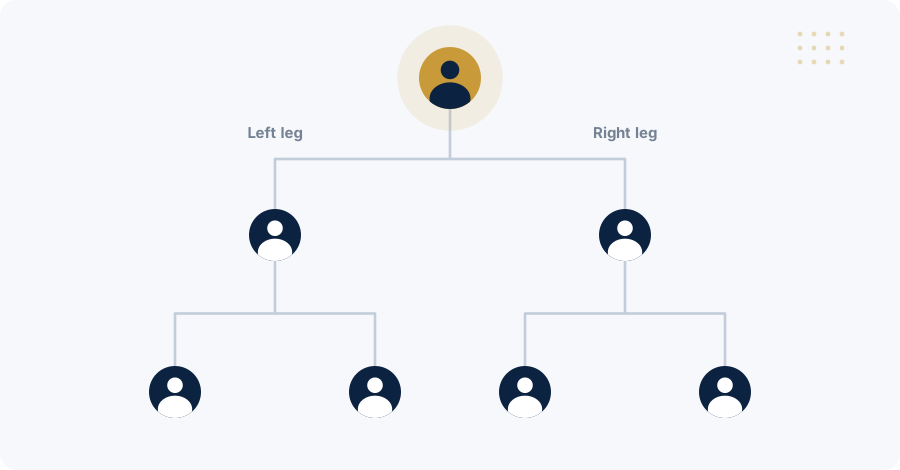
Each distributor has exactly two frontline positions — a left leg and a right leg. Any additional recruits are placed further down one of the two legs (spillover). Commission is paid as a "pairing bonus" whenever sales volume balances between the two legs, up to a capped amount per day or per cycle.
- Every distributor has exactly two frontline positions — a left leg and a right leg. No more, no less.
- Anyone recruited beyond those two — by the distributor or by their upline — gets placed further down one of the two legs. This is spillover.
- Sales volume accumulates separately on each leg as the tree grows.
- Whenever volume on both legs matches up to the plan's pairing ratio, a pairing bonus is paid. Any excess on the stronger leg either carries forward or is flushed, depending on plan design.
Spillover and pairing
Unlike Unilevel, Binary plans use spillover on purpose — once your two frontline positions are filled, anyone else recruited (by you or your upline) is placed further down one of your two legs. This means a strong sponsor's overflow can land in your team and help you qualify for pairing bonuses, but it also means your earnings depend on both legs growing at a similar pace, not just on how many people you personally recruit.
A worked example
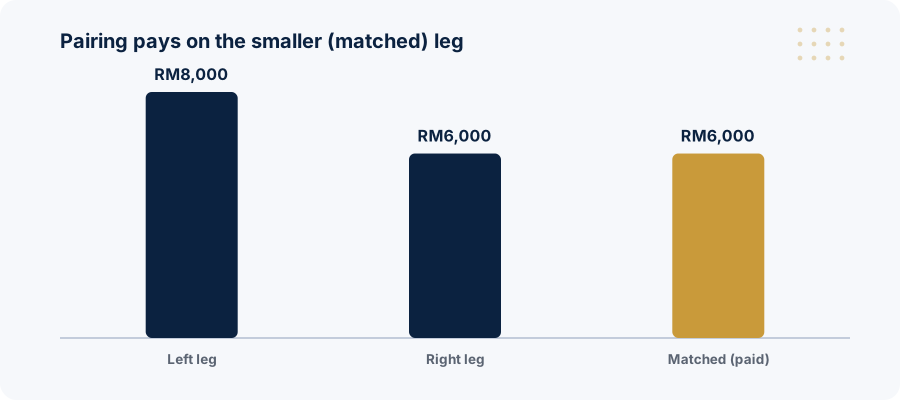
Say a distributor's left leg generates RM8,000 in sales volume this cycle and their right leg generates RM6,000. At a 1:1 pairing ratio, the matched volume is RM6,000 — the smaller of the two legs. At a 10% pairing rate, that's RM600 in commission. The unmatched RM2,000 on the left leg either carries forward to next cycle or is flushed, depending on the plan's rules.
Typical bonus types
- Pairing bonus — the core bonus, paid when matched volume appears on both legs.
- Matching bonus — a percentage of a personally-sponsored distributor's own pairing bonus, rewarding sponsors for recruiting active builders.
- Flush-out / carry-forward rule — governs what happens to unmatched volume once a cycle closes.
- Cycle bonus — an additional bonus for completing a set number of pairing cycles within a period.
- Rank / leadership bonus — unlocked once cumulative team volume or rank thresholds are hit.
Pros and cons
Pros
- ✓Spillover can help newer or slower-starting distributors benefit from a strong sponsor's overflow.
- ✓Encourages balanced team-building rather than one-sided recruiting.
- ✓The two-leg structure is visually simple to track.
- ✓Well suited to fast, high-volume recruitment campaigns.
Cons
- ✕Earnings depend on both legs growing at a similar pace — one weak leg limits payout regardless of the other.
- ✕Spillover placement needs clear, fair rules or it becomes a source of disputes.
- ✕Payout caps are almost always required to keep the plan financially sustainable.
- ✕Can be harder to explain to brand-new distributors than Unilevel.
How it compares to other plans
| Plan | Frontline width | Spillover | Best suited to |
|---|---|---|---|
| Unilevel | Unlimited | No | First-time, easy-to-explain plans |
| Binary | 2 legs | Yes | Fast, recruitment-driven growth |
| Force Matrix | Fixed (e.g. 3) | Yes | Bundled, low-cost entry packages |
| Breakaway | Unlimited | No | Leadership-heavy organisations |
Why companies choose it
Binary plans encourage distributors to help balance their downline rather than only recruit endlessly on one side, and spillover can help newer distributors benefit from a sponsor's wider network. It suits companies expecting fast, high-volume recruitment.
What to configure
Pairing ratio, daily/weekly payout caps, carry-forward vs. flush rules, and matching bonus percentages are all configurable — see the Analysis Module for how volume and payouts are tracked per leg. Want to see the numbers for your own pairing ratio? Try the commission calculator.
Common questions about the Binary plan
Yes. Once your two frontline positions are filled, anyone else recruited by you or your upline is placed further down one of your two legs, which is different from Unilevel where every recruit joins your own frontline.
It depends on the plan's rules — some carry unmatched volume forward to the next cycle, others flush it once the cycle closes. Carry-forward rewards patience; flushing keeps the payout schedule predictable.
Matched volume — the smaller of the two legs — multiplied by the pairing rate, usually capped at a daily or weekly limit.
Without one, a single very strong leg paired repeatedly against a smaller one could generate an unsustainable payout. Caps keep the plan financially predictable.
Binary always has exactly two legs with pairing-based commission. Force Matrix has a fixed width (often 3 or more) and depth, paying a percentage per level instead of pairing volume.
Yes — most real Binary plans layer a matching bonus and a rank or leadership bonus on top of the core pairing bonus.
See it configured for your compensation plan
We'll walk you through how this fits with the rest of the platform.
Get in Touch